Federal comments on the 2027 Medicare rule close September 14, 2026.
51& Learn more about 51& →
File your comment →
Regulatory analysis · plain language · July 2026

One document shapes how women's health gets paid for in 2027. You have until September 14 to help write it.

This one rule sets how women's health gets paid for, everywhere: private insurance is benchmarked to these same Medicare rates. We read all 716 pages and turned them into plain language, charts, and exactly where your voice counts.

716pages in the proposed rule
0mentions of menopause, hormone, or osteoporosis
+15%proposed raise for the new maternity care codes
Sept 14days left to comment
Start here

What is this, and why should you care if you're not a policy person?

The Physician Fee Schedule is Medicare's price list: what a doctor gets paid for every service. This 716-page draft is CMS's proposed changes to it for 2027, and it reaches far past Medicare.

Medicare sets the pricesThese proposed changes decide what Medicare pays for each service in 2027.
Private insurance follows themMany commercial contracts pay a percentage of Medicare's rates, usually within a contract cycle or two.
Practices follow the moneyWhat pays well gets offered, staffed, and taught. What doesn't gets squeezed.
You feel it in the exam roomHow long your appointment lasts, which tests you're offered, and what your plan covers.

Because it's still a draft, CMS must review and respond to the substantive comments it gets before finalizing. Comments carry real weight, and the window closes September 14.

And it's yours. Medicare is public money, funded by the taxes and premiums working people pay in. This is your system, and you have every right to weigh in on how it values women's health.

The three findings that frame everything

Part of women's health is being fixed. The rest just got an open door. And we have a chance to lay the groundwork.

The pattern underneath is structural: women's health care has been underserved, underinvested, and undervalued for decades. This rule is where that machinery is open, and naming it starts to change it.

Finding 1

Maternity care is being actively modernized.

  • The decades-old bundle covering all of pregnancy through delivery is being split into individual codes.
  • Medicare proposes paying the new labor and delivery codes 15% more than its own advisory committee recommended. A rare upward correction.
  • One open question: whether to delay it with transition codes. Comments decide.
Finding 2

The rest of women's health has an open door.

  • Menopause, hormone, and osteoporosis appear zero times in 716 pages. Rules are built from the input CMS gets, and women's health needs more people at the table.
  • This cycle, CMS is asking for exactly that: five open RFIs, an editable quality bundle, a redesigned prevention visit.
  • The biggest opening in years. First movers write the template.
Finding 3

This is our chance to lay the groundwork.

  • We can't rewrite the system in one cycle. We can put the structural problems on the federal record, where the next fix begins.
  • Name how the process that values medical work has undervalued women's health for decades, and how reform could fix it.
  • Every comment that documents the pattern makes the next fix easier to win.
This is common ground. Prevention and root-cause care, transparency in how medical work gets valued, decades of underinvestment: this rule is one of the few places those priorities line up. It's nonpartisan by design, and CMS is asking everyone.
The full analysis · free · 11 pages

Get the analysis. Stay for the response.

Drop your email and the PDF is yours. You'll also be first to get our joint comments, section-by-section guidance, and the comment tool we're building. No spam, unsubscribe anytime.

In a hurry? Skip the list and download the PDF directly →

Or keep scrolling for the full breakdown: the charts, the two ways to comment, and where your field fits.

The rule, in charts

What we saw, through a women's health lens.

Every number comes straight from the rule, cited to its exact location in the full analysis. Deep pink marks a cut or a gap; teal marks the machinery and the wins.

The words that appear zero times in 716 pages.

Full-text mentions in the proposed rule. Mechanically verified: searchable and reproducible in the rule PDF.
0menopause
0hormone
0osteoporosis
0contraception
0postpartum
0perinatal
0migraine
1midwife
What isn't named in payment policy doesn't get codes, measures, or coverage pathways. The comment period is the correction on the federal record.

The maternity payment package, rebuilt.

Code changes dissolving the single all-of-pregnancy payment into individual services.
Deleted Created Revised Deleted: 17 legacy codes Created: 12 new codes Revised: 9 codes 17 12 9
In the same section, CMS asks whether to slow the change with transition codes. Comments decide which way it goes.

Medicare proposed paying maternity care more than its advisors recommended.

New labor & delivery code values, indexed to the advisory committee's recommendation = 100.
Committee CMS proposal Advisory committee recommendation: index 100 CMS proposal: index 115, a 15 percent increase 100 +15%
The clearest evidence in years that when under-valuation is documented, Medicare corrects it. The same door is open for the rest of women's health.

The pelvic exam supply pack, repriced.

The overhead Medicare assigns to the supplies used in a well-woman exam.
Today: $20.16 Proposed: $2.81 today proposed $20.16 $2.81 −86%
Baked into every office code that uses the pack. Small line items, multiplied across every visit, are what keep a practice's doors open.

Same-day care gets a haircut.

Proposed payment when a visit and a procedure happen on the same day.
Most expensive service Everything else that day Most expensive service: paid at 100 percent Every other same-day service: paid at 50 percent 100% 50%
Exam plus biopsy, visit plus IUD, monitoring visit plus IUI: the standard patterns of office gynecology and fertility care. Private insurers tried this before and backed off. A finalized Medicare version re-arms them.

The quiet cut that compounds: what $100 of GYN surgery value becomes.

A proposed "efficiency adjustment" trims procedure values 2.5% every three years, across the board, including all GYN surgery. No specialty-level evidence; one economy-wide number.
$100 $95 $90 value today 2027: $97.50 2030: $95.06 2033: $92.69 2036: $90.37 2027 2030 2033 2036 $90.37
For procedures already documented as under-valued, an across-the-board cut widens the gap every cycle. Time-based visits, telehealth, and new codes are exempt.

The window, and what's after it.

The comment period is the short teal segment. Everything downstream is decided by what gets filed in it.
July 16, 2026: proposed rule published September 14, 2026: comments close (docket CMS-2026-2377) ~November 2026: final rule expected January 1, 2027: rule takes effect February 10, 2027: misvalued-code nominations due today Jul 16 · published Sep 14 · comments close ~Nov · final rule Jan 1 · in effect Feb 10 · nominations
Whoever files comments by September 14 writes the record the final rule answers to. Then a second window opens to nominate the 55+ under-valued GYN surgery codes for review.
View all chart data as a table
FigureValueWhere in the rule
Mentions of menopause / hormone / osteoporosis / contraception / postpartum / perinatal / migraine0 eachFull-text search, reproducible
Mentions of midwife1RHC practitioner list
Maternity codes deleted / created / revised17 / 12 / 9§II.D.4.c.(27), 91 FR 43880
Labor & delivery values vs committee recommendation+15%§II.D.4.c.(27)(a), ~91 FR 43881
Pelvic exam supply pack (SA051)$20.16 → $2.81PE supply section
Same-day visit + procedure payment100% / 50%§II.D.(58), ~91 FR 43908
Efficiency adjustment−2.5% every 3 years§II.D.2.b, ~91 FR 43868
Comment deadlineSept 14, 2026 · docket CMS-2026-2377Rule DATES section, 91 FR 43842
How to be heard

Two ways to weigh in. Everyone has a role.

This isn't a fight with CMS. It's an answer to one: CMS is asking, and women's health is answering, to help get 2027 right.

Two kinds of input, two jobs: comment on what CMS has proposed, or answer the open questions shaping rules it hasn't written yet. Both go to docket CMS-2026-2377 by September 14, and you don't need to know what an RVU is to do either.

One docket, two ways in
Comment on the proposals

CMS has already drafted these. By law it must read and respond to comments before finalizing, so your comment shapes what takes effect January 1, 2027.

On the table right now:
  • The same-day visit + procedure cut, which pays every stacked service after the first at 50%
  • The 86% cut to the pelvic exam supply pack baked into every well-woman visit
  • Remote patient monitoring (RPM) restrictions that break outsourced postpartum programs
  • The maternity transition-code question, and who is allowed to bill the new codes
  • How to value the new lactation consultant staff type

Notice something else? Email us at hello@51and.com

Answer the open questions (RFIs)

CMS is also asking for input on rules it hasn't written yet. These answers become the record future proposals are built from.

The five open RFIs:
  • The CPT coding & valuation system, where codes are missing and how valuation could be fairer
  • Primary care redesign, how longitudinal, counseling-heavy care gets paid
  • The Annual Wellness (well-woman) Visit, and what a rebuilt prevention visit should contain
  • Specialty care attribution, crediting the OB/GYNs who serve as a woman's main doctor
  • Quality data infrastructure, which data elements the system can even measure

Comment on today's rules, lay the groundwork for tomorrow's, or both. Either way, you're on the record. If you work in, invest in, or care about women's health, this is your homework.

Five asks women's health can put on the record

Examples, drawn straight from the rule. Adapt them to your own experience and expertise.

  1. Add a menopause management measure to the federal women's health quality set. None exists today.
  2. Extend osteoporosis screening below age 65 for postmenopausal women at risk, consistent with existing guidelines.
  3. Build menopause status, bone health, and midlife cardiovascular risk into the redesigned Annual Wellness Visit.
  4. Use empirical, sex-aware data to correct the GYN codes documented as undervalued, and make a sex-disparity check routine in how work is valued.
  5. Define fair billing pathways for the full maternity and lactation workforce, including who can bill the new codes.
Go deeper, based on where you stand

What's addressed, what to watch, and where to comment. By field.

Maternal health
What's addressed
  • The all-of-pregnancy payment bundle is dissolved into individual codes, following the field's own 2025 clinical guidelines.
  • The new labor and delivery codes get a proposed 15 percent raise over the advisory recommendation.
  • Lactation care gets its first Medicare codes and staff type.
Be aware
  • CMS asks whether to freeze the old bundle with transition codes instead. The modernization can still stall.
  • New remote monitoring rules ban outsourced monitoring vendors, which breaks many postpartum hypertension programs as built.
  • The rule is silent on who can bill the new codes. Midwives are mentioned once in 716 pages.
Where to comment
  • Support the new codes, or spell out the transition path your practice actually needs.
  • Name the billing pathways the broader maternity workforce needs, before that silence becomes policy.
  • Tell CMS what a lactation consultant's work is worth. It's openly asking.
Menopause & midlife health
What's addressed
  • By name: nothing. Menopause, hormone, and osteoporosis appear zero times.
  • But the structures midlife care needs are all being built right now: the wellness visit redesign, longitudinal care categories, and a group visit code that fits menopause education perfectly.
Be aware
  • The women's health quality bundle has no menopause measure and starts bone screening at 65.
  • The telehealth flexibilities every virtual menopause company runs on expire December 31, 2027.
  • Whoever answers these design questions writes the template. Right now, nobody has.
Where to comment
  • Put menopause into the wellness visit redesign: status, fracture risk, heart risk.
  • Supply real longitudinal care data. CMS asked for it specifically.
  • Request a menopause management measure by name, and cite the zero-mention finding itself.
Fertility
What's addressed
  • The overhead formulas behind every ultrasound and office procedure are being rewritten.
  • The coding RFI is an open invitation to name the gaps: no dedicated codes for infertility counseling or preconception planning.
Be aware
  • The same-day cut hits cycle care directly: monitoring visit plus IUI, visit plus biopsy, at 50 percent. Private payers tried this and retreated; a Medicare version re-arms them.
  • The cost rebuild excludes reproductive endocrinology from its underlying survey.
  • Fertility has zero federal quality measures, which makes the field invisible in the system that defines quality.
Where to comment
  • Ask for same-day exceptions where stacking is medically unavoidable, like ovulation timing.
  • Ask CMS, in a fair and pointed way, how this rule implements the February 2025 IVF executive order it never cites.
  • Propose a fertility and preconception assessment in the redesigned wellness visit.
Autoimmune, heart, and chronic conditions
What's addressed
  • Real money is moving toward longitudinal chronic-condition care: better complexity payments, a rebuilt care management code family.
  • Behavioral health payment rises substantially, favorable for depression and anxiety care women disproportionately use.
Be aware
  • New payment models are being built around named conditions, and women-predominant conditions are currently absent from every list.
  • The Alzheimer's lifestyle RFI never mentions sex, though women are two-thirds of patients. Migraine, three times more common in women, appears zero times.
  • No quality measure anywhere is sex-stratified.
Where to comment
  • Name your condition into the new specialty model pipeline. CMS says it's exploring additions now.
  • Ask for sex-stratified measurement in the new patient-outcome pipelines, from the start.
  • Weigh in on caregiver training payment. Women are the majority of unpaid caregivers, and it's quietly on the table.
General & preventive women's health practice
What's addressed
  • A sprawling primary care redesign asks how to pay longitudinal, counseling-heavy care better.
  • Rural clinics get new standalone preventive visits, a template that could extend to lactation, screening, and bone density.
  • CMS asks how to credit specialists who function as a patient's main doctor, which is millions of women's OB/GYNs.
Be aware
  • The economics of the well-woman visit are being reset item by item: the same-day cut and the 86 percent supply pack cut land on its standard patterns.
  • Telehealth flexibilities live on a statutory cliff again: December 31, 2027.
Where to comment
  • Share real supply and time costs. Empirical data now beats surveys, by CMS's own statement.
  • Support OB/GYN recognition in the main-doctor attribution question.
  • Ask for the rural preventive template to cover more women's health services. CMS says it doesn't plan to. Challenge the ceiling.

Not in the industry, but you have a story?

Federal comments from patients and caregivers count too, and personal experience is real evidence. We're building a simple guide just for you, for 51& members and anyone who wants to comment from lived experience rather than a spreadsheet. It's coming soon. Add your email above and we'll send it the moment it's ready.

This one's on all of us

The biggest opening in years is right in front of us. Let's show up in force.

Women's health organizations file comments every year. What moves the record is force: comments in numbers, backed by data and real stories, more than women's health has ever put on one docket.

These rules draw thousands upon thousands of public comments. The goal: women's health represented in more than 51% of them.

Represented, not repeated. Not a flood of identical form letters (the agency counts those as one), but thousands of distinct, substantive comments that add up to a majority the record can't ignore.

You have homework here if you…

That's everyone. A federal comment docket is one of the few places our numbers become power on the record, exactly the way they're supposed to. When women unite, the system shifts. This is where the math becomes real.

What to do by September 14 ↓
Deadlines and doors

What to do by September 14.

One action, and it's easier than it sounds: you can file a comment in about five minutes, no policy background required. Here's how, and what makes one count.

How to file, in 5 steps
  1. Go to regulations.gov and search docket CMS-2026-2377. No account needed.
  2. Click Comment. A text box opens.
  3. Write in your own words. One page is plenty. For a longer comment, attach it as a PDF.
  4. Choose how to identify yourself: as an individual, on behalf of your organization, or anonymously. Note: comments post publicly, including anything you include.
  5. Submit. You'll get a tracking number. Done.
What makes a comment count
  • Specific and first-hand: what you've seen, treated, built, invested in, or paid for.
  • Backed by data or a concrete example, not sentiment alone.
  • Tied to a real part of the rule. Use the by-field breakdown above for yours.
  • In your own words. A form letter counts as one comment; your distinct voice counts as one more. Please don't copy-paste.
Coming soon from 51&: a guided tool that walks you to the sections that matter for your work and drafts a properly filed federal comment with you, in minutes. It's the upgrade to the steps above. The email list gets it first.
Receipts, not promises

Every load-bearing claim in the analysis is cited to its exact location in the rule, with a verification status. If we couldn't verify it, we said so. That's how we work.
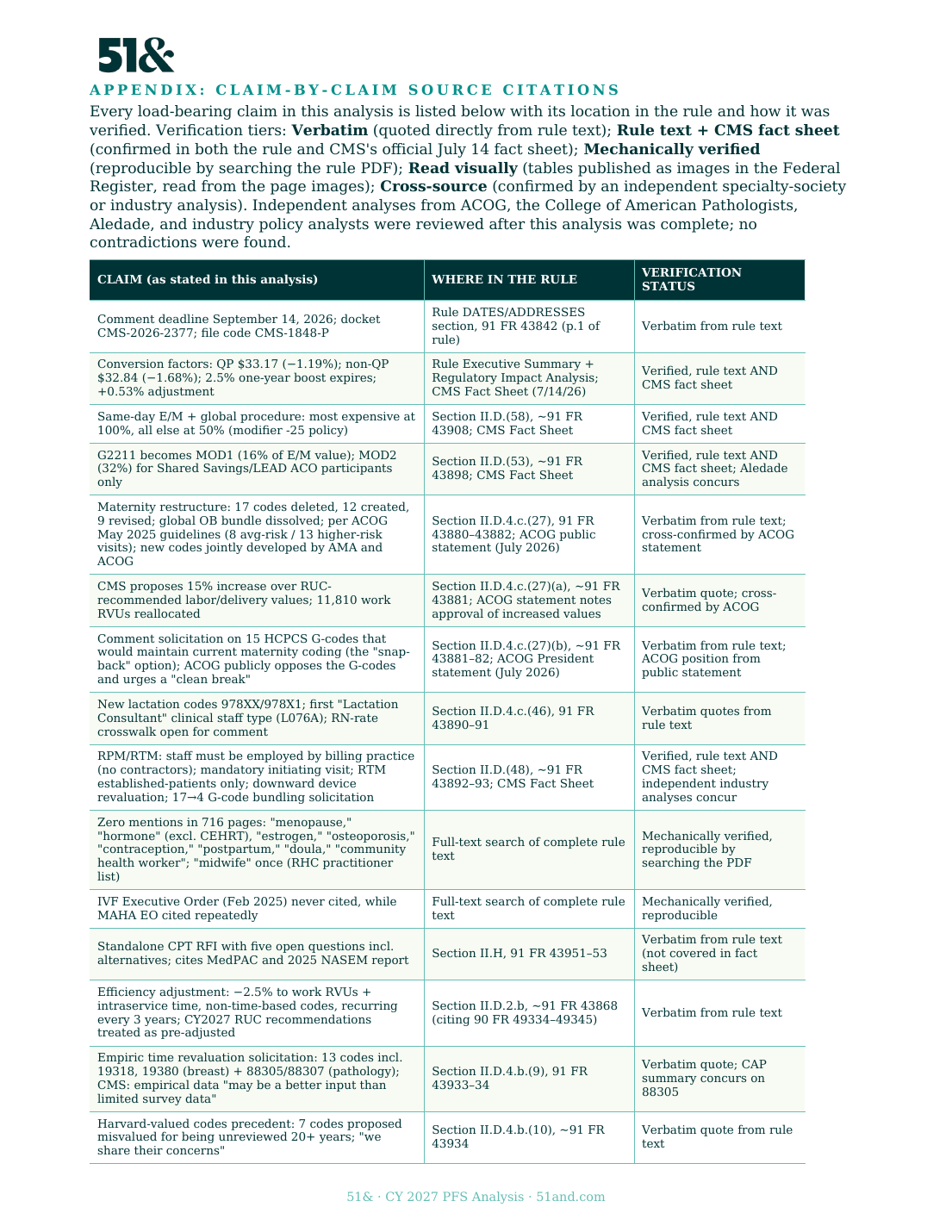
A sample of the claim-by-claim source citation table from the analysis, showing each claim, where it appears in the rule, and its verification status. A sample of our claim-by-claim citation appendix. Every figure on this page traces to a row like these. Open the full analysis →

Questions, corrections, or a women's health lens we haven't covered? Want to contribute expertise to a joint comment? Write us: hello@51and.com